Post-Fossil Fuel Civilization
A Proof-of-Concept Architecture for Mercury Orbit Space-Based Solar Power — orbital mechanics at 0.387 AU, thin-film GaAs & perovskite-tandem PV advances, microwave power transmission, global HVDC supergrid integration, and a 2030–2080 implementation roadmap.
Key Metrics
Executive Summary
Humanity stands at a civilizational inflection point. Global CO₂ emissions reached a record high in 2024 even as renewable energy investment surpassed $2 trillion for the first time. Renewables — led by wind and solar — now account for 34.3% of global electricity, with solar surging 31% year-over-year to overtake coal in H1 2025. Yet terrestrial renewables face fundamental constraints: land use, weather intermittency, diurnal cycles, and transmission losses from remote generation sites. A post-fossil-fuel civilization requires not an incremental improvement but a qualitative leap in the architecture of energy.
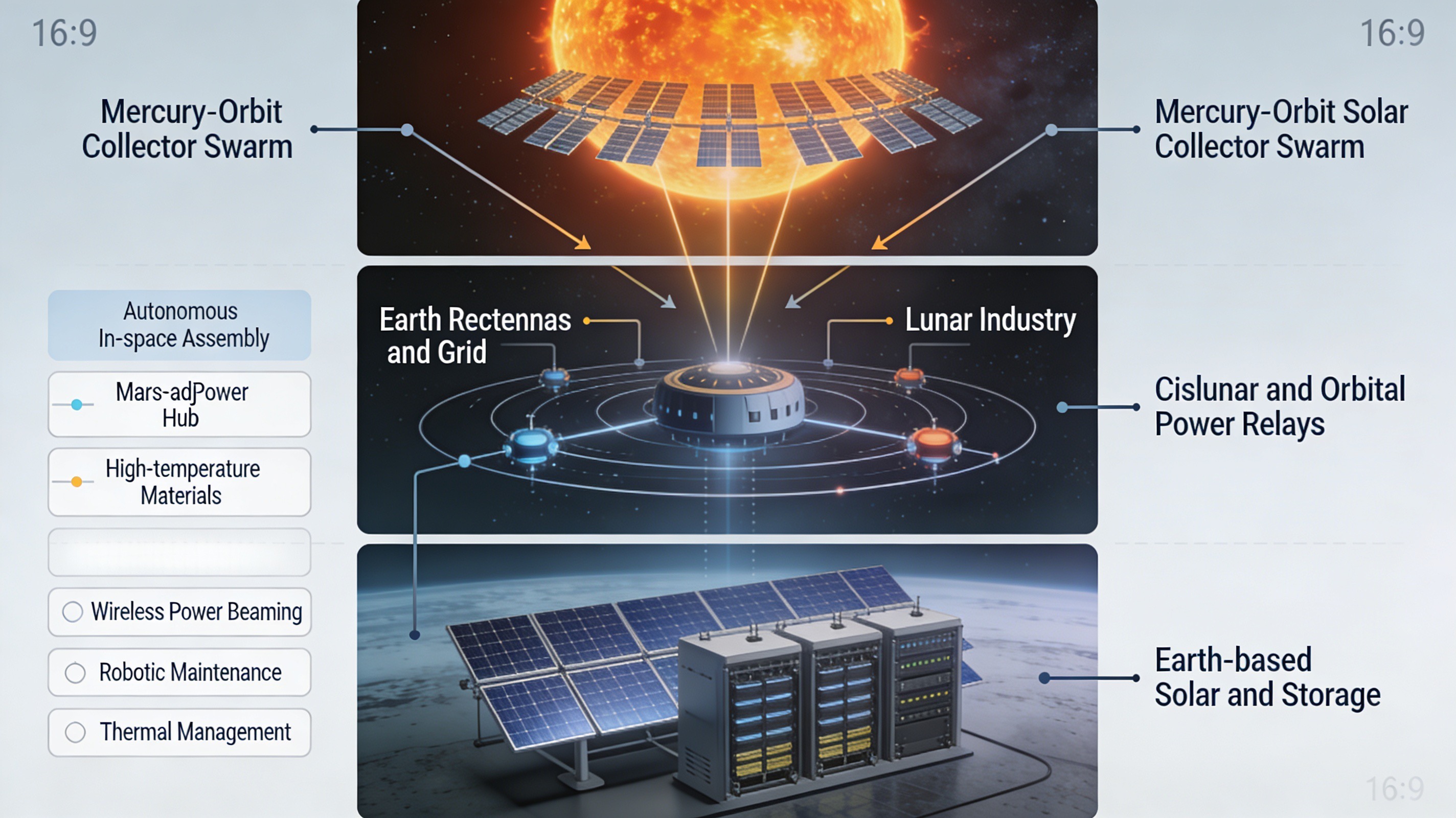
This white paper presents a comprehensive systems architecture for Space-Based Solar Power (SBSP) collected in Mercury orbit — a paradigm that exploits the inverse-square law of solar irradiance to access energy flux of 6,272–14,448 W/m² (vs. 1,361 W/m² at Earth), transmitted via microwave to a planetary network of ground receivers and a global HVDC supergrid. The proposal integrates breakthrough thin-film PV advances (perovskite-silicon tandems reaching 34.85% certified efficiency in 2025), validated microwave WPT chain efficiencies, and orbital mechanics derived from Mercury's known parameters (a = 0.387 AU, e = 0.206, T = 87.97 days).
I. The Civilizational Energy Imperative
Every major civilizational transition has been predicated on an energy transition: from biomass to coal, from coal to petroleum, and from petroleum to the distributed electricity systems now emerging. The transition now underway is unique in its urgency and its physics: the atmosphere's carbon budget for a 1.5°C outcome is nearly exhausted, and the scale of energy required by a fully electrified civilization of 10 billion people in 2050 is estimated at 50,000–65,000 TWh per year — more than double current generation.
Space-based solar power bypasses terrestrial constraints entirely: it is available 24 hours per day, 365 days per year, with no seasonal variation or cloud cover attenuation, and can be directed to any point on Earth's surface via beam steering. In Mercury orbit, the solar resource is 6.6–10.6 times more intense than at Earth.
| Metric | 2024 Value | 2050 Projection | Source |
|---|---|---|---|
| Global electricity demand | 29,000 TWh/yr | 50,000–65,000 TWh/yr | RFF/BNEF 2025 |
| Renewable share of generation | 34.3% | 50–74% (all scenarios) | Ember 2025 |
| Solar installed capacity growth | 562 GW added (2023) | ≥950 GW/yr required | IEA NZE |
| Clean energy investment | $2.0 trillion (2024) | $4–6 trillion/yr needed | IEA WEO 2024 |
| CO₂ emissions trajectory | Record high 2024 | Net zero by 2050 | IEA |
II. Mercury as Energy Source: Orbital Physics
Mercury occupies the innermost orbit of the solar system with a semi-major axis of 0.387 AU and eccentricity of 0.206 — the highest of any planet. Solar irradiance at heliocentric distance r follows S(r) = S₀ / r², where S₀ = 1,361 W/m² at 1 AU.
| Orbital Position | Distance (AU) | Solar Irradiance (W/m²) | Multiplier vs. Earth |
|---|---|---|---|
| Earth (reference) | 1.000 | 1,361 | 1.0× |
| Mercury — Aphelion | 0.4667 | 6,272 | 4.6× |
| Mercury — Mean Orbit | 0.3871 | 9,116 | 6.7× |
| Mercury — Perihelion | 0.3075 | 14,448 | 10.6× |
Orbital Mechanics Considerations
- Co-orbital Mercury-trailing swarm — gravitational shepherding and shared trajectory management; requires station-keeping against perturbations and intense solar pressure.
- Independent heliocentric ring at r = 0.40 AU — flexible geometry, avoids Mercury's thermal environment; ~8,506 W/m² (still 6.2× Earth).
- Mercury L4/L5 Lagrange positioning — gravitational stability with no station-keeping fuel; ~9,100 W/m² with persistent orbital stability.
III. Solar Collector Platform — Proof-of-Concept
A modular, self-assembling hexagonal tile system inspired by Caltech's SSPD-1/SSPP and NASA's 2024 SBSP Innovative Heliostat Swarm study.
| Platform diameter | 50 m per module (hexagonal) |
| Active PV area | ~1,800 m² per platform |
| PV technology | Flexible GaAs thin-film, 35% efficiency |
| Specific power | ~300 W/kg (target: 500 W/kg) |
| Power per platform (mean orbit) | ~5.7 MW electrical |
| Transmitter array | Phased microwave array, 2.45 GHz, rear-facing |
| Thermal management | Radiative panels + circulating heat pipes; <200 °C |
| Station-keeping | Ion thrusters; solar pressure compensation sails |
| Phase 1 swarm size | ~40,000 platforms |
IV–IX. Transmission, Ground Infrastructure, Distribution & Roadmap
The full white paper details the microwave power transmission chain (DC→RF→beam→rectenna→DC), Earth ground-receiver infrastructure, the global HVDC supergrid for redistribution, the 2030–2080 phased implementation roadmap, an economic and policy analysis, and a conclusion with recommended next steps for research institutions, governments, and private actors.
Read the complete analysis with figures, tables, citations, and references in the downloadable PDF.